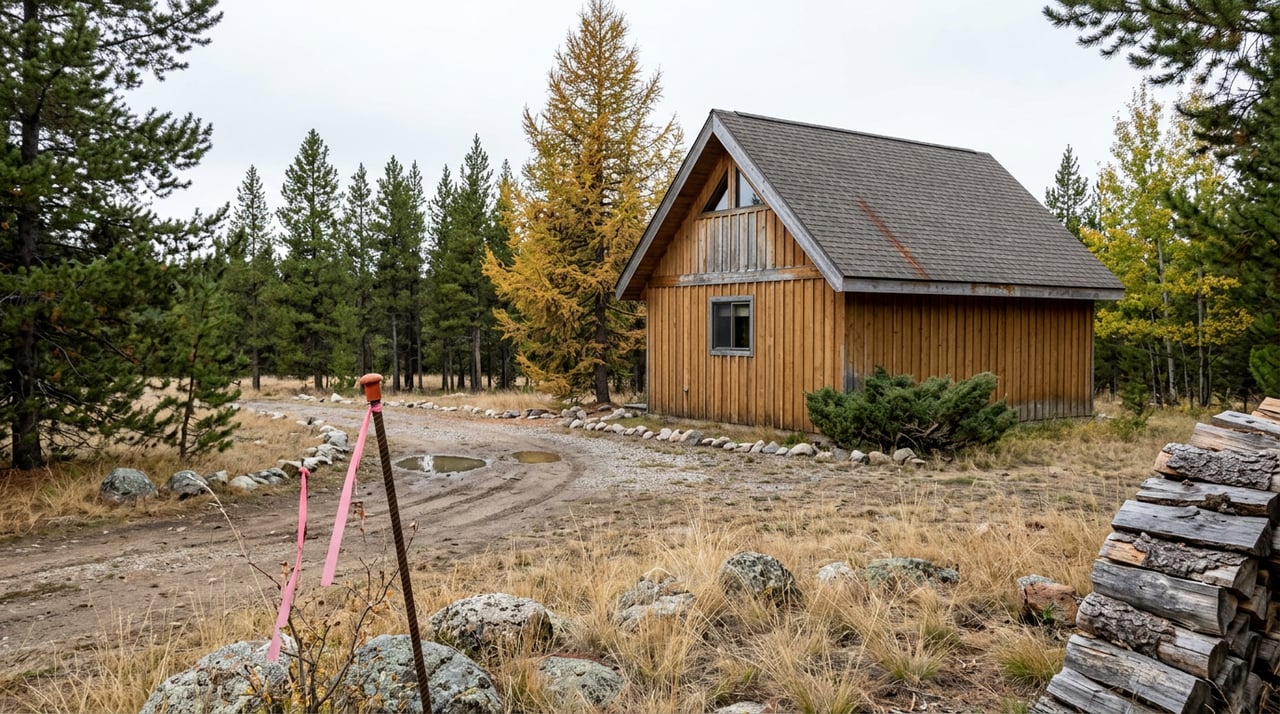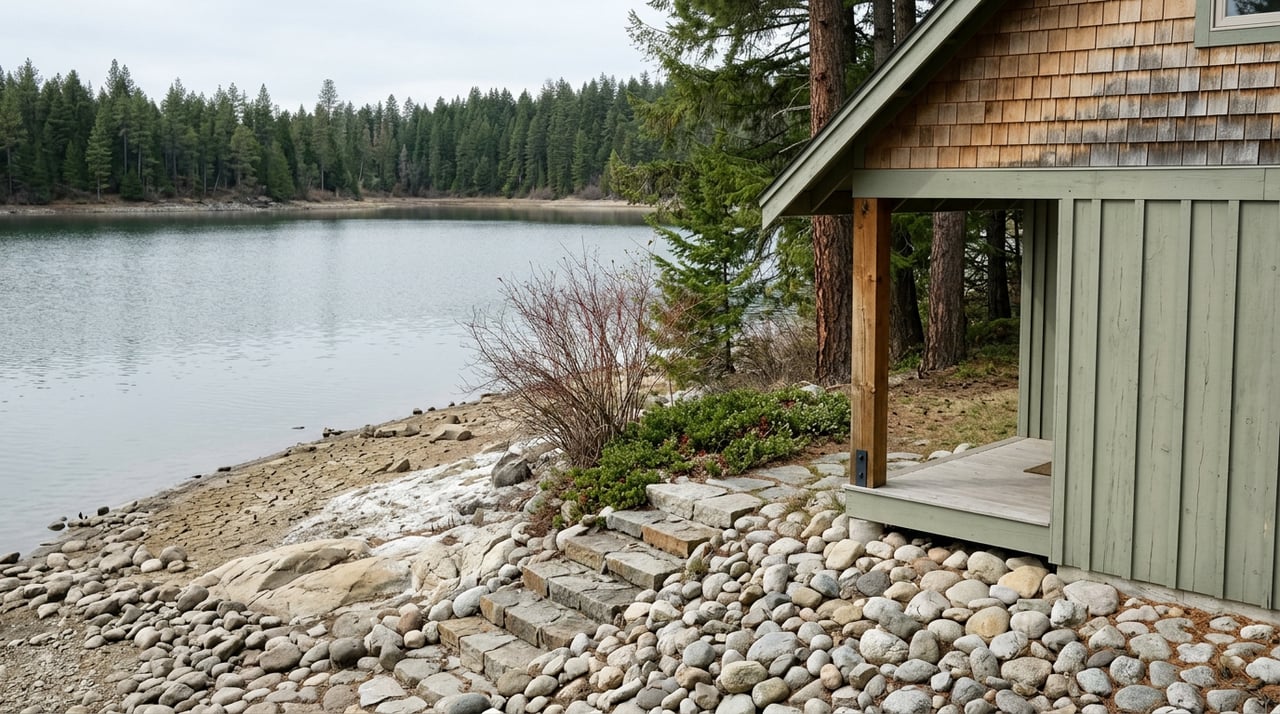
A buyer walked a lot above Pine Bay with me in June this year. The water was right where the listing photos promised, lapping at the rocks below a stand of larch. She came back in early August to walk it again before writing an offer. The shoreline had pulled back several feet. Same lot, same summer, different lake.
That is not erosion and it is not a drought story, even though 2026 has actually been a near-average water year in the Kootenai basin. It is Lake Koocanusa doing what it was built to do, which has very little to do with how full it looks to someone shopping for waterfront.
The lake has a full pool number, and it is not the same as "full"
Lake Koocanusa's design summer target, the elevation engineers call full pool, is 2,459 feet. The reservoir's own bathymetric survey work puts the practical range even wider, from a minimum pool of 2,290.84 feet up to a maximum pool of 2,462.84 feet, documented by USGS after multibeam surveys completed between 2016 and 2018. That is a swing of more than 170 vertical feet between the lowest the reservoir is allowed to go and the highest it can hold, on a lake with 90 miles of shoreline. A natural lake in the Flathead Valley does not have a number like that. Koocanusa does, because it was never a lake. It is a storage tank on the Kootenai River, and the U.S. Army Corps of Engineers decides how full to keep it based on flood risk, hydropower, and fish, in that rough order, with recreation and shoreline aesthetics somewhere further down the list.
As of the Corps' most recent operations update, the projected pool elevation for Koocanusa this month sits around 2,453 feet, about six feet under full pool according to the Corps' late-May 2026 report. That update also noted the April-through-August water supply forecast at 116 percent of average for the season. This is worth sitting with for a second. This was not a dry year. Snowpack ran ahead of normal. And the lake is still six feet shy of its own summer target during the exact weeks Rexford waterfront gets the most showings.
Why a wet year doesn't guarantee a full lake
The Corps has to satisfy several jobs with the same water, and they don't happen in the order a boat owner would prefer.
Every spring, before the reservoir is allowed to refill, the Corps has to hold space for flood risk downstream and release a scheduled pulse of water for white sturgeon spawning. The 2026 operations notes describe that pulse directly: outflows ramped from 10,000 cfs up to 25,000 cfs over two days in late May, held at peak for about two weeks, then stepped back down to a summer flat flow near 10,000 cfs. That entire operation runs on the calendar the fish need, not the calendar a lake house buyer needs, and it exhausts a chunk of the water that might otherwise have gone toward filling the reservoir sooner.
In a drier year, the math gets worse fast. In 2025, one of the driest years on record for the basin, the Corps' water supply forecast dropped from 4,944 thousand acre-feet to 4,670 thousand acre-feet in the span of a single month, and officials capped the end-of-September target elevation at 2,446.7 feet to protect downstream salmon and steelhead flows, well short of the summer design pool. Nobody in Rexford voted on that number. It was set by an environmental flow requirement tied to fish hundreds of river miles away.
This has been going on long enough that it shows up as a recurring seasonal worry rather than a one-off surprise. A few years back, RVwest reported a Canadian official describing the annual ritual on the B.C. side of the border where the same reservoir stretches into the Kootenays:
residents keep an eye on Lake Koocanusa to ensure that it isn't getting too low
That is the honest version of what "waterfront" means here. It is not a fixed line on a map. It is a number that moves depending on snowpack, flood-space requirements, and fish flow obligations that get decided well upstream of any listing agreement.
What the numbers have actually looked like
| Year | Water supply outlook | Approximate peak pool elevation | What drove it |
|---|---|---|---|
| Design target | — | 2,459 ft | Normal summer conservation pool |
| 2020 | Average | 2,451 ft (peaked Aug. 9) | Baseline year for comparison |
| 2021 | 88% of average | 2,448–2,452 ft | Below-average snowpack |
| 2025 | Roughly bottom decile in 74 years | Capped near 2,446.7 ft (Sept. target) | One of the driest years on record, ESA flow caps |
| 2026 | 116% of average (May forecast) | ~2,453 ft (early-to-mid August) | Above-average snowpack, still short of full pool |
The pattern that matters for a buyer isn't any single row. It's that even the best row on this table, an above-average snowpack year, still lands six feet under design pool. That tells you the ceiling on this lake in midsummer is structurally lower than "full," almost every year, regardless of how much snow fell in the Purcells that winter.
What this actually changes if you're shopping Rexford waterfront
I'm not telling buyers to avoid the lake. Rexford's stretch of Koocanusa is still one of the more distinctive waterfront markets in northwest Montana, with the Kootenai National Forest at its back, the old Tobacco River railroad grade for family bike rides, and Abayance Bay's marina and restaurant anchoring the summer social calendar. I'm telling buyers to shop it with the mechanism in mind instead of the photo.
A few things I walk clients through before they write an offer on a lake lot here:
- Ask where the parcel line sits relative to the 2,459-foot full pool contour, not relative to today's waterline. A lot that looks like it has forty feet of beach in August might have almost none in a high-water June.
- Ask whether the property's dock or stairs were engineered to reach the water across the full operating range, or only at a specific pool elevation. A structure built for a 2,455-foot summer won't necessarily reach the water in a year like 2025.
- If private shoreline access matters more than convenience, understand that communities like Mariners Haven and Pine Bay largely solved this problem by pairing home sites with marina slips and shared launches instead of relying on a private dock that has to chase a moving shoreline every season.
- Tour more than once if you can, ideally once in late spring before the reservoir has finished filling and again in August, so you're judging the lot against both ends of its normal range instead of a single snapshot.
- Treat the Corps' seasonal operations updates as a resource, not fine print. They are public, they are specific, and they tell you what the lake is actually projected to do this year rather than what a listing photo implies it always does.
A few questions I hear often
Will the reservoir come back up before Labor Day? Based on this year's projections, the pool is expected to hold in roughly the 2,453-foot range through August rather than climb back toward full pool, since the Corps' summer flat-flow operations are already underway and there isn't a mechanism that pushes the lake higher again until next year's runoff.
Does a lower pool actually hurt resale value on Rexford waterfront? It affects how a specific lot shows and functions more than it affects the broader appeal of owning on Koocanusa. Lots with engineered docks, marina access, or a shallow enough grade to keep water within reach across the operating range tend to show consistently well regardless of where the pool sits that week.
Is there one place to check the current elevation before I tour a property? The Corps and USGS both publish current reservoir data, and I share the specific gauge readings with buyers before every Rexford waterfront showing so nobody is judging a lot off a single day's water line.
If you're comparing Rexford to other Northwest Montana lake markets, or you just want someone who tracks the Corps' seasonal updates as closely as the MLS, that's the kind of groundwork Charity Waldo does before a client ever steps onto a dock. You can browse current Rexford listings and neighborhood notes, or if you're ready to talk specifics about a lot you've found, reach out through the buyer resources page. Talk to Charity. Get the read on the water before you get the read on the offer.